Industrial Engineering
Industrial Engineering seniors are equipped with a diverse set of skills that they apply in their capstone/senior design projects to optimize processes and systems in various industries. These projects focus on improving efficiency, productivity and quality while ensuring safety and sustainability.
Projects start in spring only and last 1 semester. Project proposals are due mid-October. Submit your proposal here:
Student Skills:
- Process Optimization: Designing and optimizing processes to enhance service delivery, reduce waste, and improve quality.
- Data Analysis: Using Machine Learning/AI to predict equipment failures and analyze real-time data to detect quality deviations.
- Quality Control: Applying statical process control and design of experiments to monitor process stability and identify optimal process settings, respectively, for desired performance.
- Process Improvement: Applying Lean and Six Sigma to identify inefficiencies, optimize workflow, and improve operational efficiency and quality.
- Safety Analysis: Conducting systematic risk assessments to design safer work environments and mitigate operational risks.
- Facility Design: Optimizing facility layouts to ensure efficient material flow as well as reduce waste, lead time, and inventory costs.
- Sustainability: Assessing environmental risks and enhancing supply chain sustainability.
- Additional Skills:
- Using simulation and modeling for decision-making
- Enhancing reliability and quality for long-term operational effectiveness and durability
- Conducting cost-benefit analyses to ensure economic viability and strategic investment
Previous Project Examples:
Optimizing Tool Management for Efficiency
Sponsored by NRG
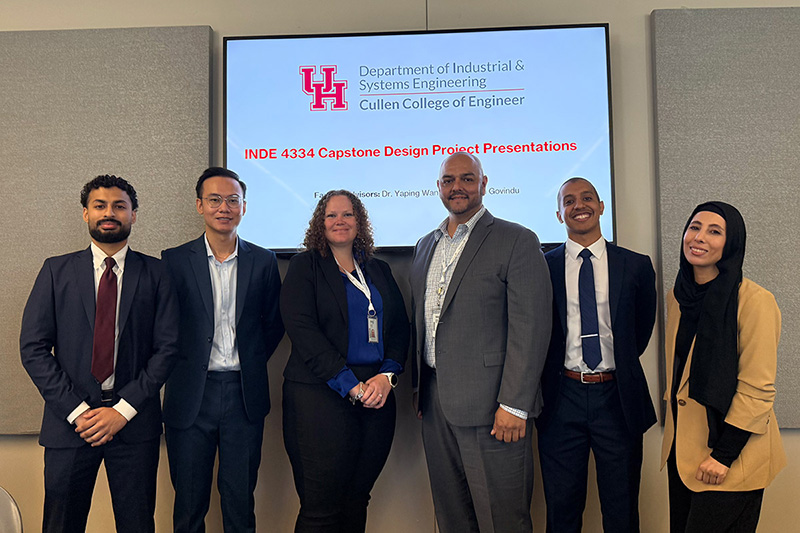
This project addressed inefficiencies in tool management at NRG Energy Services’ Central Repair Shop that led to long search times, higher costs and reduced productivity. Using Lean Six Sigma methods—Spaghetti Diagrams, Voice of the Customer (VOC) and cost-benefit analysis—the team identified workflow bottlenecks and developed solutions to standardize tool organization, optimize layouts and introduce digital tracking. Key improvements include micrometer checkout stations, tool placement by usage frequency and a 50 percent reduction in search time. The proposed framework enhances efficiency, minimizes safety risks and offers a scalable model expected to achieve full return on investment within 15 months.
Team Members: Suhaib, Hafadi, Huy, Taha Saad
Operating Room Turnaround Time Reduction
Sponsored by HCA-Clear Lake
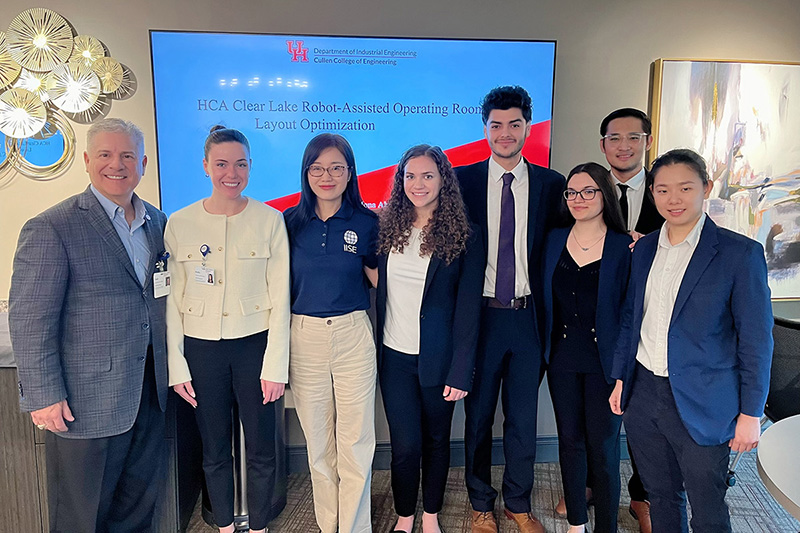
This project investigated prolonged Room Turnaround Time (RTAT) at HCA Clear Lake and developed targeted solutions to enhance operating room efficiency. The hospital’s RTAT exceeded its 30-minute benchmark, causing scheduling delays and added costs. Using Lean methods and S.M.A.R.T. objectives, the team analyzed workflows, identified bottlenecks and proposed standardized processes to improve equipment readiness and staff coordination. Key actions included clearer task roles, streamlined communication and optimized resource use. The proposed improvements are expected to shorten RTAT, reduce revenue loss per surgery and improve staff satisfaction—supporting HCA’s goal of achieving an average RTAT of 30 minutes or less.
Team members: Olivia Garza, Mona Almufti, Jesus Zendejas, Phung Huynh
“The University of Houston industrial engineering students were professional to work with and very knowledgeable and thorough in their efforts. They spent countless hours observing our teams, even as early as 6:00am, and conducted several interviews with key stakeholders, from nurses to surgeons, to understand our opportunities in depth. They also came prepared with weekly status updates and asked insightful questions to provoke meaningful discussion. Overall, the students leveraged their knowledge of process improvement tactics to provide opportunities for improved efficiency.”
— Shelby DeRose
Assistant Administrator
HCA Houston Healthcare Clear Lake